AeroCater tracks every truck, driver, and trolley in real time, and flags which flights are likely to come back with food. The person who built it spent years doing this by hand first, so it doesn't guess at what dispatch actually needs.
"Generic logistics software doesn't know what a hydraulic scissor lift is, or a WB/NB pairing rule, or a 4-hour food-safety window. I got tired of bending someone else's software to fit an industry it wasn't built for, so I built my own."
— Founder, AeroCater · former in-flight catering dispatcher
"At the unit you see it every day — trolleys coming back off the aircraft still full, food nobody touched. And when a flight cancels after it's already been catered, all of that gets thrown out too. Cutting the waste was a big part of why I wanted to build this."
— Founder, AeroCater · former in-flight catering dispatcher
Before a truck leaves, the board flags the flights that will probably come back with food. It looks at how full the plane is and how many meals were ordered. A dispatcher sees that and can call the kitchen. What to cater in the first place comes from what the station did over the last two weeks and how booked tonight's flights are. Whatever still gets thrown away is logged, with the reason why. When a trolley comes back, whoever's at the dish pit scans it and logs what's left and why. It's a record for that one trolley, not a guess made at the end of a shift.
Not a repurposed trucking platform. Every feature is built around the specific mechanics of in-flight catering.
Matches trucks and drivers by drive-transition time, workload balance, and turnaround risk. It won't book a driver outside their shift or double-assign a truck.
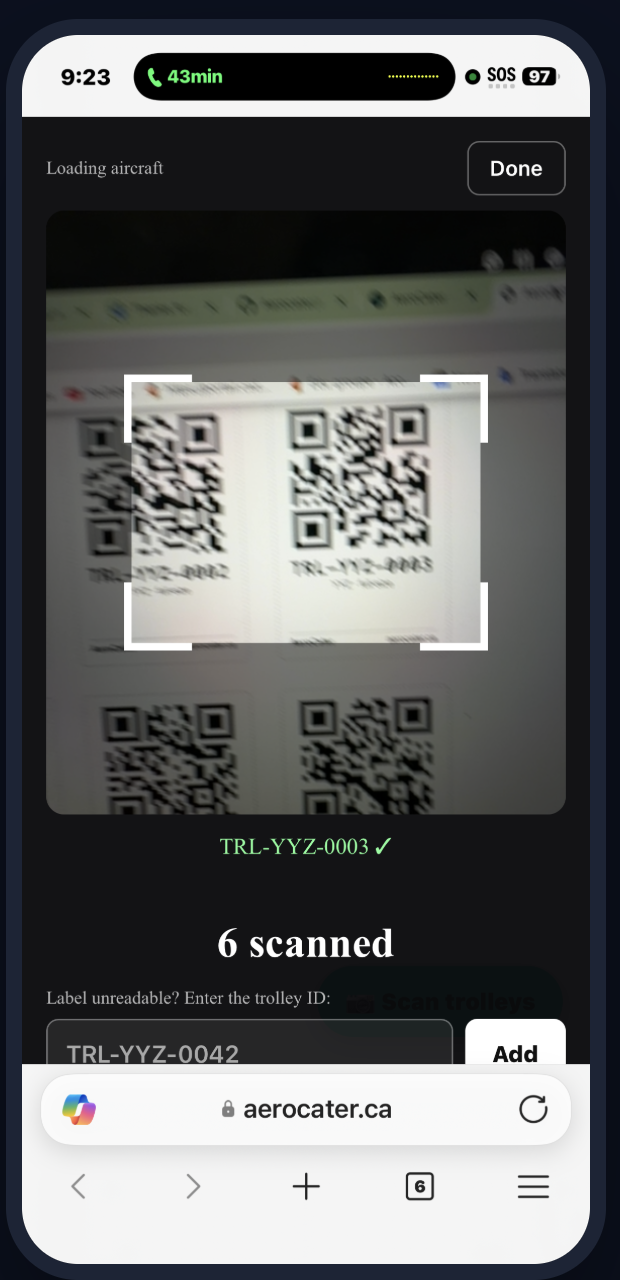
Every trolley carries its own QR identity, so you know exactly when it left the kitchen, boarded the aircraft, and came back. Every scan is timestamped.
Drivers check in and scan trolleys from a personal link. No separate login, no desktop, and it works one-handed at the unit.
Live hydraulic cycles, service windows, and alerts surface issues before a truck fails mid-turnaround.
Every truck load gets sealed and logged. The driver verifies it blind — no seal number ever reaches their screen — and a mismatch flags dispatch immediately, per flight, per truck.
Truck maintenance issues and trolley waste-returns raise a real alert on the dispatch board the moment they're logged, not a report you read the next morning.
Scope 1 fuel use and waste figures come from logged entries, not an estimate. Export an audit-ready report whenever a customer or regulator asks.
See every truck's position on one map. GPS-ready for a live Samsara feed, so dispatch doesn't have to guess where a truck is going to be next.
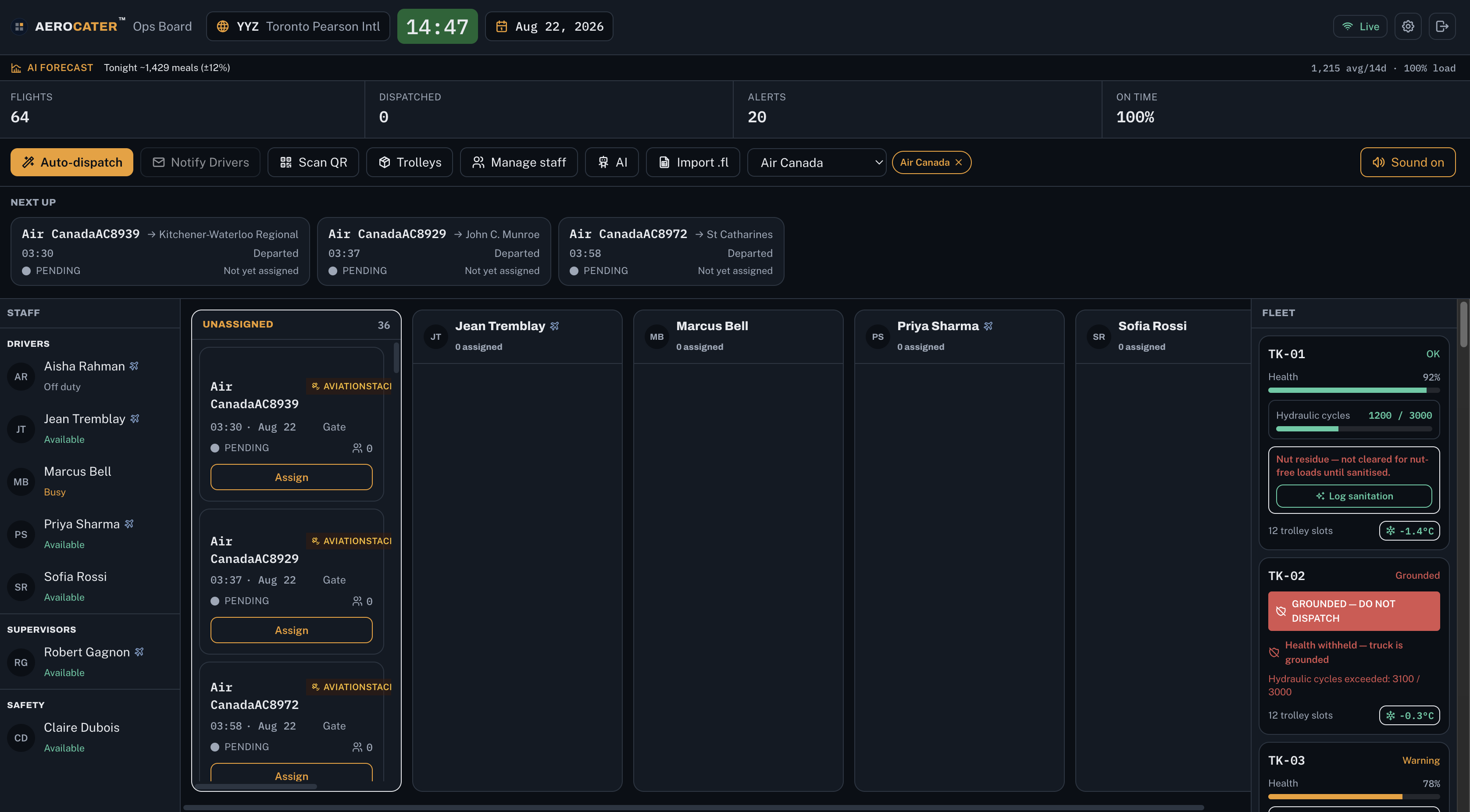
This is a real AeroCater ops board running a live station, not a mockup.
Every shift, every driver, grouped and visible at a glance.
Unassigned flights on one side, driver columns on the other.
Truck health and live warnings, updated in real time.
No app to download, no separate password. Just a personal link and a camera.
Straight answers about how AeroCater is built and run. No vague reassurances.
All data is encrypted in transit and stored with row-level security, so every user only ever sees the station and role they're authorized for. It's hosted on Supabase, which is SOC 2 Type II certified.
No shared logins. Every scan and every check-in is tied to a specific person, with a full audit trail.
Food-safety windows, turnaround buffers, and shift boundaries are enforced in the dispatch logic itself, not left to a spreadsheet.
You reach the people who build AeroCater directly, not a tiered support desk reading from a script.
A rule-based safety score per station, built from real signals — override-PIN failures, groundings, seal mismatches, cold-chain breaches. Disclosed as a heuristic, not sold as AI.
AeroCater is priced around your fleet size and station count, not a flat per-user fee that punishes you for growing your team. Tell us about your operation and we'll size a plan around it.
Get pricing →